|
📝
Uttar Pradesh Subordinate Services Selection Commission (UPSSSC)📝 Preliminary Eligibility Test (PET) Examination 2026📋 UPSSSC PET 2026 – Complete Notification | Vacancy, Syllabus, Eligibility & Apply Online
📝 Group B & C Eligibility Test | Score Card Valid for 1 Year | Fee: ₹185/₹95/₹25
|
|||||||||||||||||||||||||||||||
|
📅
📆 Important Dates📌
Application Start
03 Aug 2026
⏰
Last Date Apply
01 Sep 2026
💳
Pay Exam Fee
01 Sep 2026
✏️
Correction Date
08 Sep 2026
📖
Exam Date
Update Soon
🎫
Admit Card
Before Exam
|
|||||||||||||||||||||||||||||||
|
💰
Application FeeGeneral / OBC / EWS
₹185/- SC / ST
₹95/- PH (Divyang) / PwD
₹25/- 💳 Payment Modes (Online): Debit Card | Credit Card | Net Banking | IMPS | Cash Card / Mobile Wallet | UPI
🎂
Age Limits (01 July 2026)Minimum Age
18 Years Maximum Age
40 Years ℹ️ Age Relaxation Extra as per UPSSSC PET Rules & Government Norms for Reserved Categories
|
|||||||||||||||||||||||||||||||
|
📊
📋 Vacancy Details & Eligibility
✅ PET Score Card Valid for 1 Year
📝 Apply for Multiple Group B & C Posts 🎯 Single Exam for All Posts |
|||||||||||||||||||||||||||||||
|
📖
📖 UPSSSC PET Exam Pattern 2026
📝 Objective Type (MCQs)
❌ Negative Marking: 1/4th 🌐 Bilingual (Hindi & English) |
|||||||||||||||||||||||||||||||
|
📝
📝 How to Apply Online – Step by Step1
📋 Read Full Notification Carefully Before Applying Online 2
📄 Collect All Required Documents – Marksheet, ID Proof, Photo, Signature 3
🖥️ Visit Official Website – upsssc.gov.in & Click Apply Online Link 4
📝 Fill Complete Form & Upload Scanned Documents Carefully 5
💳 Pay Application Fee Online & Submit Form 6
🖨️ Take Printout of Final Submitted Form for Future Reference |
|||||||||||||||||||||||||||||||
|
🔗
🔗 Important Links |
|||||||||||||||||||||||||||||||
|
📢 Candidates are advised to read the full notification carefully before applying online.
© 2026 ExamJobResult.com – All Rights Reserved | For Latest Sarkari Exam Updates Visit Regularly
|
|||||||||||||||||||||||||||||||
Blog
-
UP Police Constable Result 2026
🚔Uttar Pradesh Police Recruitment & Promotion Board (UPPRPB)
🚔 UP Police Constable Recruitment 2025 – Advt. No. 07/2025
📋 Short Details of Notification – Total 32,679 Vacancies🚨 10+2 Pass | Age 18-25/28 Years | Male/Female | Physical Test Required | Apply Now⚠️ All dates as per official UPPRPB notification. Check uppbpb.gov.in for updates.📅Important Dates
📌Application Begin31/12/2025⏰Last Date30/01/2026📝Correction31/01 – 03/02/2026 (06 AM)📖Exam Date08-10 June 2026🎫Admit Card3 Days Before Exam📊Result31/07/2026💰Application Fee & Age Limit
General / OBC / EWS₹500/-SC / ST₹400/-🎂 Age Limit (as on 01/07/2025)Male: 18-25 Years | Female: 18-28 Years
Relaxation as per UPPRPB rules.Payment via E-Challan, Debit/Credit Card, Net Banking.📊Vacancy Details – Total 32,679 Posts
Post Name General EWS OBC SC ST Total Constable Civil Police (Male/Female) 4191 1046 2826 2198 208 10469 Constable PAC / Armed Police (Male) 6060 1512 4083 3176 300 15131 Constable Special Force Battalion (Male) 538 134 362 281 26 1341 Constable Female Battalion (Lko, Badaun, Gkp) 916 228 615 478 45 2282 Constable Horseman (Male) 30 07 19 14 01 71 Jail Warden (Male) 1314 327 885 688 65 3279 Jail Warden (Female) 44 10 28 22 02 106 🚔 Grand Total – – – – – 32,679 🏃Physical Eligibility (PET/PST)
📏 Height
Male: 168 cm (General/OBC/EWS) | 160 cm (ST)
Female: 152 cm (General/OBC/EWS) | 147 cm (ST)💪 Chest (Male Only)
Male: 79-84 cm (Gen/OBC/EWS) | 77-85 cm (ST)
Female: Not Applicable🏃 Running
Male: 4.8 Km in 25 Minutes
Female: 2.4 Km in 14 Minutes📌How to Apply – UP Police Constable 2025
- 1 Apply between 31/12/2025 to 30/01/2026 on UPPRPB official website.
- 2 Read full notification before applying. Prepare scanned photo, signature, ID proof.
- 3 Pay fee via E-Challan/Debit Card/Credit Card/Net Banking. Fee: ₹500 (Gen/OBC/EWS), ₹400 (SC/ST).
- 4 Check preview, submit form. Correction window: 31/01/2026 to 03/02/2026 (till 06 AM).
- 5 Print confirmation page. Exam: 08-10 June 2026. Admit card available 3 days before.
🔗Some Useful Important Links
📄 Result PDFClick
📊 Download CutoffClick
🔑 Final Answer KeyClick
🗝️ Answer KeyClick
🎫 Download Admit CardClick
🏙️ Exam City NoticeClick
✏️ Correction / Edit FormClick
📝 Apply OnlineClick
📢 Download NotificationClick
🌐 ExamJobResult.comVisit
🏛️ UPPRPB Official WebsiteClick🔧 Tools: Image Resizer, Age Calculator, Resume CV Maker & More – ExamJobResult Tools📢 Join ExamJobResult Channels & Download Apps🚔 UP Police Constable Recruitment 2025 – Advt. 07/2025 | Total 32,679 Vacancies
📝 10+2 Pass | Age 18-25/28 | PET/PST Required | Fee: Gen ₹500, SC/ST ₹400 | Exam: 08-10 June 2026
🌐 Stay updated at ExamJobResult.com & official UPPRPB website. All links are placeholders – check official site for actual URLs.
-
UPSC CMS ADMIT CARD 2026
🏥Union Public Service Commission (UPSC)
🏥 Combined Medical Services (CMS) Examination 2026
📋 UPSC CMS 2026 – Complete Exam Details | Notification, Syllabus, Admit Card & Result🏥 Medical Officer Posts | 2 Papers (500 Marks) + Interview (100) | MBBS Required | Admit Card Available Now⚠️ Tentative dates based on official UPSC calendar 2025 pattern. Confirm on upsc.gov.in.📅Important Dates
📌NotificationFeb 2026📝Apply OnlineFeb-Mar 2026⏰Last DateMar 2026📖CMS ExamJuly 2026🎫Admit CardJune/July 2026📊ResultOct/Nov 2026💰Application Fee & Eligibility
General / OBC / EWS₹200/-SC / ST / PwBD / Female₹0/- (Exempted)🎓 EligibilityMBBS Degree from Recognized University + Internship Completed + MCI/NMC Registration📊CMS Exam Pattern & Selection Process
Stage Paper Subject Marks Written Paper I General Medicine & Pediatrics 250 Paper II Surgery, OBG, Preventive & Social Medicine 250 Interview Personality Test / Viva Voce 100 📊 Grand Total 600 📝 Objective Type (MCQs)
❌ Negative Marking: 1/3rd
⏱️ 2 Hours per Paper
🏥 Both Papers Same Day📚Complete Syllabus – UPSC CMS 2026
📝 Paper I – General Medicine & Pediatrics (250 Marks)
General Medicine: Cardiology, Respiratory, Gastroenterology, Neurology, Nephrology, Endocrinology, Hematology, Infectious Diseases, Rheumatology, Dermatology, Psychiatry, Emergency Medicine, Toxicology, Nutrition, Immunology.
Pediatrics: Growth & Development, Neonatology, Nutrition, Immunization, Infectious Diseases, Respiratory, Gastrointestinal, Cardiovascular, Neurology, Nephrology, Genetics, Child Health Programs, IMNCI, Pediatric Emergencies.📝 Paper II – Surgery, OBG & PSM (250 Marks)
Surgery: General Surgery, Trauma, Burns, Orthopedics, Ophthalmology, ENT, Anesthesia, Urology, Neurosurgery, Plastic Surgery, Wound Healing, Fluid Management, Surgical Infections, Oncology.
OBG: Antenatal, Intranatal, Postnatal, High-Risk Pregnancy, Family Planning, Gynecology, Menstrual Disorders, Infertility.
PSM: Epidemiology, Biostatistics, Environmental Health, Nutrition, Communicable/Non-Communicable Diseases, MCH, National Health Programs, RMNCH+A, Health Planning, Hospital Administration.🎫Admit Card – Download & Important Instructions
📥 How to Download Admit Card1️⃣ Visit upsc.gov.in or upsconline.nic.in
2️⃣ Click “e-Admit Card” → Select CMS 2026
3️⃣ Enter Registration ID & Date of Birth
4️⃣ Complete Captcha → Click Submit
5️⃣ Download & Print admit card (2-3 copies)⚠️ Exam Day Instructions✅ Carry Printed Admit Card + Original Photo ID
✅ Reach 60 mins before reporting time
✅ No electronic devices (mobile, calculator, watch)
✅ Carry Black Ball Point Pen
✅ Follow dress code guidelines
✅ Verify all details on admit card📉Previous Year Cutoff – UPSC CMS (Reference)
Category Written Cutoff (Out of 500) Final Cutoff (Out of 600) General ~320-340 ~400-420 OBC ~310-330 ~390-410 SC ~280-300 ~360-380 ST ~270-290 ~350-370 ⚠️ Above data is based on previous trends. Actual CMS 2026 cutoff may vary.💡Preparation Guide & Recommended Books
📅 Phase 1: Foundation (Months 1-2)
Complete MBBS standard textbooks revision. Focus on high-yield topics: Medicine (Cardiology, Neurology, Infectious), Surgery (Trauma, General Surgery), OBG (Antenatal, Labor), PSM (Epidemiology, NHPs). Practice 50 MCQs daily.📅 Phase 2: Intensive (Months 3-4)
Solve previous 10 years UPSC CMS papers. Take 10-15 full-length mock tests. Focus on time management – 2 hours per paper. Revise weak subjects. Practice image-based and clinical case-based MCQs.📚 Recommended Books
Medicine: Harrison/Davidson, Surgery: Bailey & Love/Schwartz, OBG: Shaw/Williams, Pediatrics: Ghai/OP Ghai, PSM: Park/Mahajan & Gupta, Previous Year: UPSC CMS Solved Papers by Arihant/Pulse, MCQs: Across PG/NEET PG pattern MCQs.🏆 Career After CMS
Posts: Medical Officer (Railways, Ordnance Factories, Delhi Municipal), ADMO, GDMO. Pay Scale: Level 10 (₹56,100-₹1,77,500) + NPA + DA. Benefits: Govt accommodation, CGHS, Pension, Job Security, Work-Life Balance, Promotion to CMO/Specialist.📌How to Apply for UPSC CMS 2026
- 1 Visit upsconline.nic.in – Complete One Time Registration (OTR) if not done.
- 2 Apply between February – March 2026. Fee: Gen/OBC/EWS ₹200 | SC/ST/PwBD/Female ₹0.
- 3 Documents Required: MBBS Degree, Internship Completion Certificate, MCI/NMC Registration, Photo, Signature, ID Proof.
- 4 CMS Exam: July 2026 | Admit Card: June/July 2026 | Result: Oct/Nov 2026.
- 5 Pay fee online via SBI MOPS, check preview & take printout of confirmation page.
❓Frequently Asked Questions
❓ UPSC CMS Notification Release Date?
✅ February 2026❓ CMS 2026 Exam Date?
✅ July 2026❓ Application Fee?
✅ Gen/OBC/EWS: ₹200 | SC/ST/PwBD/Female: ₹0❓ Total Marks?
✅ Written: 500 + Interview: 100 = 600 Marks❓ Negative Marking?
✅ Yes – 1/3rd marks deducted for wrong answer❓ Eligibility for CMS?
✅ MBBS Degree + Completed Internship + MCI/NMC Registration❓ How to download Admit Card?
✅ upsc.gov.in → e-Admit Card → Enter Reg ID & DOB❓ Official Website?
✅ upsc.gov.in | upsconline.nic.in📢 Join Our Channels for UPSC CMS 2026 Updates🔗Some Useful Important Links
🏥 UPSC CMS 2026 – Complete Exam Guide | Medical Officer Posts | 500 Marks Written + 100 Interview
📝 2 Papers (Medicine + Surgery/OBG/PSM) | Negative Marking 1/3rd | MBBS Required | Fee: Gen ₹200 | SC/ST/Female Free
📅 Visit UPSC Official & ExamJobResult.com for notification, admit card, answer key, result & interview updates.
-
UPESSC UP Principal Online Form 2026
🎓Uttar Pradesh Education Service Selection Commission (UPESSC)
🏫 UP Principal Recruitment 2026 – Advt No. 02/2026
📋 UPESSC Advt. No. : 02/2026 : Short Details of Notification🏫 Total : 111 Posts | PhD + 15 Yrs Experience | Max Age: 62 Yrs | Exam: 24 Sep 2026 | Fee: ₹3000 All📅Important Dates
📌Application Begin21 July 2026⏰Last Date Apply20 Aug 2026💳Fee Last Date20 Aug 2026✏️Correction23 Aug 2026📖Exam Date24 Sep 2026🎫Admit CardBefore Exam⚠️ PhD + 15 Years Experience Required | Max Age: 62 Years | Fee: ₹3000/- for ALL Categories | Exam: 24 Sep 2026💰Application Fee
General / OBC / EWS / SC / ST / PH – All Categories₹3000/-Uniform Fee for ALL Categories💳 Payment : Online / Offline Fee Mode Only👤Max Age: 62 Yrs (01/06/2026)
🎯 111 PostsUPESSC Principal – Govt. Colleges🎓 Eligibility Criteria for UPESSC Principal 2026✅ Educational Qualification: PhD Degree in Relevant Subject from a Recognized University
✅ Experience: Minimum 15 Years Teaching/Research Experience in University/College/Recognized Institution
✅ Age Limit: Maximum 62 Years for Male (as on 01/06/2026)
✅ Additional: Administrative experience in educational institutions preferred
✅ Candidates must have strong academic background with research publications
📌 For complete eligibility & experience details – Read Full Notification📋Selection Process & Exam Pattern – UPESSC Principal 2026
📝Stage 1: Written Examination✅ Objective Type – Multiple Choice Questions (MCQs)
✅ Questions based on Higher Education, Administration, General Studies & Subject Knowledge
✅ Total Questions: As per UPESSC Principal Exam Pattern
✅ Duration: 2-3 Hours (to be confirmed in notification)
✅ Negative Marking: As per UPESSC norms
✅ Candidates qualifying written exam are called for Interview🎤Stage 2: Interview & Document Verification✅ Personal Interview before Selection Board
✅ Assessment of Academic Background, Research Work, Administrative Experience & Leadership Skills
✅ Document Verification: Original PhD Degree, Experience Certificates, Publications
✅ Interview carries significant weightage in final selection
✅ Final Merit List based on Written Exam + Interview Performance
✅ Selected candidates appointed as Principal in UP Government Colleges📝Step 1Online Application→📖Step 2Written Exam (24 Sep)→🎤Step 3Interview→🏫Step 4Final Merit & Appointment📚UPESSC Principal Exam – Complete Syllabus & Key Topics
🏛️ Higher Education System & Administration
UGC Regulations & Guidelines, NAAC Accreditation Process, NEP 2020 (National Education Policy), Higher Education Commission of India (HECI), AICTE, NCTE, RCI, University Grants Commission Structure, College Administration & Management, Academic & Administrative Responsibilities of Principal, IQAC (Internal Quality Assurance Cell), Autonomy in Higher Education, Ranking Frameworks (NIRF), Examination Reforms, Choice Based Credit System (CBCS), MOOCs & SWAYAM, Digital Education Initiatives.📖 General Studies & Current Affairs
Indian Polity & Constitution (Education in Concurrent List), Indian Economy (Education Budget), Government Schemes in Education (Samagra Shiksha, PM-USHA, NISHTHA), Current Affairs (National & International), UP Special (Education Schemes, Budget for Education), Science & Technology in Education, Environmental Education & Sustainable Development, Sports & Cultural Activities in Colleges, Disaster Management in Educational Institutions.📚 Teaching & Research Aptitude
Teaching Methods & Pedagogy (Traditional & Modern), Student Evaluation & Assessment Methods, Research Methodology (Types, Sampling, Data Analysis), Research Ethics & Plagiarism, Intellectual Property Rights (IPR), Publication Ethics (UGC CARE List), Funding Agencies for Research (UGC, DST, ICSSR), Institutional Research Committee, Faculty Development Programmes, Curriculum Development & Revision, Student Counseling & Guidance, Grievance Redressal Mechanism, Anti-Ragging Measures.📊 Administrative & Financial Management
Financial Management in Educational Institutions, Budget Preparation & Execution, Purchase & Procurement Rules (GFR), Store & Inventory Management, Human Resource Management (Teaching & Non-Teaching Staff), Performance Appraisal (API/PBAS), Service Rules & Conduct Rules, Disciplinary Proceedings, RTI Act 2005 in Educational Institutions, Office Management & Record Keeping, Meeting Management (Academic Council, Board of Studies), Time Management & Leadership Skills, Team Building & Motivation, Conflict Resolution, Communication Skills for Administrators.🔬 Subject Knowledge (As per PhD Specialization)
Questions based on candidate’s PhD subject specialization. In-depth knowledge of the subject, recent developments, research trends, and application in higher education. Candidates should prepare their core subject thoroughly at post-graduate and PhD level. Focus on conceptual clarity, recent research papers, and subject-specific teaching methodologies.🏫 Role & Responsibilities of Principal
Academic Leadership & Vision Setting, Faculty Recruitment & Development, Student Admission & Welfare, Infrastructure Development & Maintenance, Industry-Academia Collaboration, Placement & Career Guidance, Alumni Relations, Community Engagement & Extension Activities, Library & Laboratory Management, Hostel Management, Campus Safety & Security, Environmental Sustainability in Campus, International Collaborations & Exchange Programmes, ICT Integration in College Administration, Statutory Compliance & Legal Matters.💡UPESSC Principal – Preparation Strategy & Study Plan
📅 Phase 1: Foundation (Days 1-20)
Study UGC Regulations, NEP 2020, Higher Education System in India. Read about NAAC, IQAC, NIRF, CBCS. Cover Indian Polity (Education related articles), Government Schemes in Education. Study Research Methodology basics (types, sampling, ethics). Revise your PhD subject fundamentals. Read newspaper daily for current affairs in education sector.📅 Phase 2: Deep Study (Days 21-40)
Deep dive into Administrative & Financial Management (GFR, Purchase Rules, HR Management). Study RTI Act, Service Rules, Conduct Rules. Prepare your PhD subject in depth with recent developments. Practice writing answers on Role of Principal, Academic Leadership. Solve previous year papers and mock tests. Focus on UP Education Department schemes and initiatives.📅 Phase 3: Revision & Interview Prep (Days 41-55)
Revise all topics using short notes. Take 5-7 full-length mock tests. Prepare for Interview: Your bio-data, PhD research summary, achievements, why you want to be Principal? Practice mock interviews. Prepare answers on leadership, team building, conflict resolution. Study your college preference list. Keep all documents ready for verification.📚 Recommended Books & Resources
UGC Regulations Manual, NEP 2020 Document, NAAC Guidelines, Higher Education in India by Dr. J.C. Aggarwal, Research Methodology by C.R. Kothari, Indian Polity by M. Laxmikanth, GFR 2017, RTI Act 2005 Guide, UP Education Department Website, UGC CARE List for Publications, Subject-specific reference books as per PhD specialization.🎯 Important Tips
Focus 50% time on Higher Education & Administration (most scoring). Practice case studies on college administration problems. Prepare a 5-minute presentation on “My Vision as Principal”. Interview panel looks for leadership qualities, decision-making ability & academic vision. Keep PhD thesis summary handy – questions will be asked. Stay updated with latest UGC circulars and NEP implementation updates.🏆 Career After Becoming Principal
Pay Scale: Academic Level 14 (₹1,44,200 – ₹2,18,200) as per 7th Pay Commission. Benefits: Government accommodation (or HRA), Medical facilities, Pension under NPS, Research Grants, Study Leave, Sabbatical. Promotion Path: Principal → Regional Additional Director → Regional Director → Director of Higher Education. Respected leadership position with autonomy in academic & administrative decisions.📌How to Fill UPESSC Principal Online Form 2026
- 1 Apply between 21 July 2026 to 20 August 2026. Fee: ₹3000 for ALL categories.
- 2 Eligibility: PhD Degree + 15 Years Teaching/Research Experience required.
- 3 Correction Window: 23 August 2026 – Last date for corrections.
- 4 Exam Date: 24 September 2026 | Admit Card: Before Exam.
- 5 Collect documents – PhD Degree, 15 Years Experience Certificates, Research Publications, ID Proof, Scanned Photo & Signature.
- 6 Pay fee online/offline, check preview & take printout.
❓Frequently Asked Questions
❓ UPESSC Principal Online Form Start?
✅ 21 July 2026❓ Last Date to Apply?
✅ 20 August 2026❓ UPESSC Principal Exam Date?
✅ 24 September 2026❓ Application Fee?
✅ ₹3000/- for ALL Categories❓ Eligibility for Principal?
✅ PhD + 15 Years Teaching/Research Experience❓ Maximum Age Limit?
✅ 62 Years for Male❓ Selection Process?
✅ Written Exam + Interview❓ Official Website?
✅ uphesc.org📢 Join Our Channels for UPESSC Principal Updates🔗Important Links
🏫 UPESSC Principal Recruitment 2026 – Advt 02/2026 | 111 Posts | PhD + 15 Yrs Exp | Exam: 24 Sep 2026
📖 Written Exam + Interview | Fee: ₹3000 All Categories | Max Age: 62 Yrs | Pay Scale: Level 14 (₹1,44,200-₹2,18,200)
📅 Visit UPESSC Official & ExamJobResult.com for admit card, exam date, answer key & result updates.
-
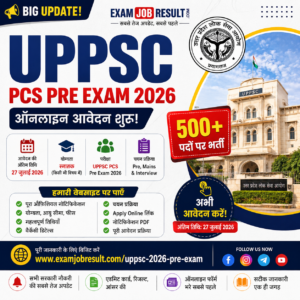
UPPSC Pre 2026 Online Form
🏛️Uttar Pradesh Public Service Commission (UPPSC)
🏆 Combined State / Upper Subordinate Services (PCS) Pre 2026 – Advt A-1/E-1/2026
📋 UPPSC Advt No : A-1/E-1/2026 : Short Details of Notification🏆 Total : 500 Posts | SDM, DSP, BDO & Gazetted Officers | Pre + Mains + Interview | Apply: 25 Jun – 27 Jul 2026📅Important Dates
📌Application Begin25 June 2026⏰Last Date Apply27 July 2026💳Fee Last Date27 July 2026✏️Correction25 Jun-03 Aug📖Pre ExamAs per Schedule🎫Admit CardBefore Exam⚠️ OTR Registration Mandatory Before Applying | Correction Window Available Till 03 Aug 2026 | 500 Gazetted Posts💰Application Fee
General / OBC / EWS₹125/-SC / ST₹65/-PH Candidates₹25/-💳 Payment : SBI MOPS Debit/Credit Card, Net Banking or SBI E Challan Mode Only👤Age: 21-40 Yrs (01/07/2026)
🎯 500 PostsBachelor Degree Any Stream | Category Wise in Notification🏆 Posts Under UPPSC PCS – Gazetted Officers🏛️ SDM (Sub Divisional Magistrate)
👮 DSP (Deputy Superintendent of Police)
🏘️ BDO (Block Development Officer)
📋 Naib Tehsildar
💰 Treasury Officer/Accounts Officer
📊 CTO (Commercial Tax Officer)
🍚 DSO (District Supply Officer)
📈 ARO (Assistant Review Officer)
🏫 BSA (Basic Shiksha Adhikari)
👔 District Administrative Officer & More📋Complete Selection Process – Pre + Mains + Interview
📝Stage 1: Pre Exam (Qualifying)✅ 2 Papers – General Studies I & II (CSAT)
✅ Objective Type (MCQs) – 200 Marks Each
✅ Duration: 2 Hours per Paper
✅ CSAT is Qualifying (33% required)
✅ Pre Score not counted in Final Merit
✅ ~12-15 times candidates shortlisted for Mains📚Stage 2: Mains Exam (Written)✅ 8 Papers – Descriptive Type
✅ GS I-VI, Essay, Hindi, Optional (2 Papers)
✅ Total: 1500 Marks (GS+Essay) + Optional
✅ Duration: 3 Hours per Paper
✅ Mains Score counted in Final Merit
✅ ~3 times candidates called for Interview🎤Stage 3: Interview (Personality Test)✅ Personality Test / Viva Voce
✅ Total: 100 Marks
✅ Tests: Personality, Leadership, GK, Decision Making
✅ Final Merit = Mains + Interview Marks
✅ Top rankers get SDM, DSP, BDO posts
✅ Training at UP Academy of Administration📚UPPSC PCS Pre 2026 – Complete Syllabus & Exam Pattern
📝 Paper I – General Studies I (200 Marks, 150 Qs)
Indian History (Ancient, Medieval, Modern), Indian National Movement, Indian Polity & Constitution, Indian Geography, World Geography, Indian Economy, General Science & Technology, Environment & Ecology, Current Affairs (National & International), UP Special GK (History, Culture, Economy, Budget, Schemes), Census 2011, Sports, Awards.📝 Paper II – CSAT (200 Marks, 100 Qs, Qualifying 33%)
Reading Comprehension (English & Hindi), Interpersonal & Communication Skills, Logical Reasoning & Analytical Ability, Decision Making & Problem Solving, General Mental Ability, Basic Numeracy (Class 10 level), Data Interpretation (Charts, Graphs, Tables), Hindi Language Comprehension.📚 Mains – General Studies Papers (6 Papers, 1500 Marks)
GS I: History, Geography, Society. GS II: Polity, Governance, International Relations. GS III: Economy, Agriculture, Science, Environment, Disaster Management, Security. GS IV: Ethics, Integrity, Aptitude. GS V: UP Specific (History, Culture, Economy). GS VI: UP Specific (Administration, Schemes). Essay: 3 Essays (150 Marks). Hindi: 100 Marks (Qualifying).📚 Mains – Optional Subject (2 Papers)
Choose 1 subject from 34 options: History, Geography, Political Science, Public Administration, Sociology, Economics, Philosophy, Psychology, Agriculture, Commerce, Management, Hindi Literature, English Literature, Urdu, Sanskrit, Law, Mathematics, Physics, Chemistry, Botany, Zoology, Anthropology, Civil Engineering, Electrical Engineering, Mechanical Engineering & more.💡UPPSC PCS – Preparation Strategy & Booklist
📅 Phase 1: Pre Foundation (Months 1-3)
Complete NCERT Class 6-12 (History, Geography, Polity, Economy, Science). Read standard books: Indian Polity by M. Laxmikanth, Spectrum for Modern History, GC Leong for Geography, Shankar IAS for Environment. Daily newspaper reading (The Hindu/Indian Express). Practice 50+ Pre MCQs daily. Focus on UP Special GK.📅 Phase 2: Pre Intensive (Months 4-5)
Revision of all GS topics. Solve UPPSC previous 10 years Pre papers. Take 10-15 full-length mock tests (Pre). Practice CSAT paper (focus on comprehension & reasoning – ensure 33%+). Revise current affairs of last 12 months. Focus on UP budget, schemes, census data.📅 Phase 3: Mains Preparation (Months 6-10)
Start answer writing practice – write 2 answers daily. Study GS I-VI in depth. Prepare optional subject thoroughly. Practice essay writing (3 essays in 3 hours). Read UP-specific books for GS V & VI. Join test series for Mains. Focus on time management – 3 hours per paper.📚 Recommended Standard Books
History: Spectrum (Modern), Old NCERT Ancient/Medieval. Polity: M. Laxmikanth. Geography: GC Leong + NCERT. Economy: Ramesh Singh + Budget. Environment: Shankar IAS. UP GK: Arihant UP Special. CSAT: RS Aggarwal. Mains: Subhra Ranjan Notes, Drishti IAS Materials. Previous Year Papers: UPPSC Solved.🎯 Important Tips for UPPSC PCS
UP GK is VERY important – 30-40% questions from UP. Solve at least 3000+ Pre MCQs before exam. For Mains: handwriting & presentation matter. CSAT is qualifying – don’t neglect it. Optional subject selection is crucial – choose wisely. Interview preparation: focus on UP issues, current affairs & your bio-data. Stay consistent – 6-8 hours daily study for 10 months.🏆 Career & Salary After UPPSC PCS
SDM: ₹56,100-₹1,77,500 (Level 10) + allowances. DSP: Same pay scale + uniform allowance. BDO: Key role in rural development. All posts get: Government accommodation, vehicle, medical facilities, pension under NPS. Promotion path: SDM → ADM → DM → Commissioner. Respected gazetted officer status in UP Government.📌How to Fill UPPSC PCS Pre Online Form 2026
- 1 OTR Registration First! Complete One Time Registration on UPPSC portal before applying.
- 2 Apply between 25 June 2026 to 27 July 2026. Fee: Gen/OBC/EWS ₹125 | SC/ST ₹65 | PH ₹25.
- 3 Correction Window: 25 June to 03 August 2026 – Corrections available throughout.
- 4 Pre Exam: As per Schedule. Admit Card: Before Exam.
- 5 Collect documents – Bachelor Degree, ID Proof, Scanned Photo & Signature.
- 6 Pay fee via SBI MOPS/E Challan, check preview & take printout.
❓Frequently Asked Questions
❓ UPPSC PCS Pre Online Form Start?
✅ 25 June 2026❓ Last Date to Apply?
✅ 27 July 2026❓ Pre Exam Date?
✅ As per Schedule❓ Application Fee?
✅ Gen/OBC/EWS: ₹125 | SC/ST: ₹65 | PH: ₹25❓ Total Vacancies?
✅ 500 Posts (Category Wise in Notification)❓ Selection Process?
✅ Pre → Mains (8 Papers) → Interview (100 Marks)❓ Is OTR mandatory?
✅ Yes – Complete OTR before applying❓ Official Website?
✅ uppsc.up.nic.in📢 Join Our Channels for UPPSC PCS Updates🔗Important Links
🏛️ UPPSC PCS Pre 2026 – Advt A-1/E-1/2026 | 500 Posts | SDM, DSP, BDO & Gazetted Officers
📝 Pre + Mains (8 Papers) + Interview (100 Marks) | OTR Mandatory | Fee: ₹125 (Gen) / ₹65 (SC/ST)
📅 Visit UPPSC Official & ExamJobResult.com for admit card, exam date, answer key & result updates.
-
UPPSC Computer Assistant Typing Test Exam Date 2026
🏛️Uttar Pradesh Public Service Commission (UPPSC)
💻 Computer Assistant Recruitment 2025 – Advt No. A-4/E-1/2025
📋 UPPSC Advt No. A-4/E-1/2025 : Short Details of Notification💻 Total : 13 Posts | Result: 13 Mar 2026 | Typing Test: 18 Aug 2026 | 10+2 + ‘O’ Level/Computer Diploma📅Important Dates
📌Application Begin01 July 2025⏰Last Date Apply01 Aug 2025💳Fee Last Date01 Aug 2025📊Result13 Mar 2026⌨️Typing Test18 Aug 2026🎫Admit CardBefore Exam⚠️ Application was in July 2025 | Result Declared: 13 March 2026 | Typing Test: 18 August 2026 | Only 13 Posts💰Application Fee
General / OBC / EWS₹125/-SC / ST₹65/-PH (Divyang)₹25/-💳 Payment : Cash at E Challan or Debit Card, Credit Card, Net Banking👤Age: 18-40 Yrs (01/07/2025)
13Total Posts09UR01EWS03OBC💻 Eligibility Details✅ 10+2 Intermediate Exam Passed from Any Recognized Board
✅ ‘O’ Level Exam Passed from NIELIT (DOEACC) OR 10+2 with Diploma in Computer Science
✅ Knowledge of Hindi in Devnagari Script
📌 More Details Read the Full Notification📊Selection Process & Exam Pattern
📝 Stage 1: Written Examination✅ Objective Type – Multiple Choice Questions (MCQs)
✅ Questions based on Computer Knowledge, General Studies, General Hindi & Arithmetic
✅ Total Marks: As per UPPSC norms (typically 100-200 marks)
✅ Duration: 2 Hours (approx)
✅ Negative Marking: As per UPPSC rules
✅ Candidates who qualify written exam are called for Typing Test⌨️ Stage 2: Typing Test (Skill Test)✅ Typing Test Date: 18 August 2026
✅ Language: Hindi Typing (Kruti Dev / Mangal Font)
✅ Speed Required: 25 Words Per Minute (WPM) in Hindi
✅ OR English Typing: 30 Words Per Minute (WPM)
✅ Duration: 10 Minutes (Qualifying Nature)
✅ Typing test is qualifying only – Final selection based on Written Exam Merit
✅ UPPSC provides font notice for typing test preparation📝Step 1Written Exam→📊Step 2Result (13 Mar 2026)→⌨️Step 3Typing Test (18 Aug)→📋Step 4Final Merit List📚Complete Syllabus & Typing Test Details
💻 Computer Knowledge
Fundamentals of Computer, History & Generations, Input/Output Devices, Memory (RAM, ROM, Cache), Storage Devices, Operating System (Windows, Linux), MS Office (Word, Excel, PowerPoint, Access), Internet & Email, Networking (LAN, WAN, MAN), Cyber Security, Computer Viruses, DBMS Basics, Programming Basics (C, C++), Web Technology (HTML, HTTP), Shortcut Keys, Full Forms, Computer Abbreviations, Latest IT Developments.📝 General Hindi (सामान्य हिंदी)
व्याकरण: संधि, समास, उपसर्ग, प्रत्यय, वचन, लिंग, कारक, काल, वाक्य शुद्धि, विराम चिह्न। शब्दावली: पर्यायवाची, विलोम, अनेकार्थी, श्रुतिसम भिन्नार्थक, मुहावरे एवं लोकोक्तियाँ। गद्यांश आधारित प्रश्न। हिंदी वर्णमाला एवं वर्तनी।📖 General Studies (सामान्य अध्ययन)
Indian History (Ancient, Medieval, Modern), Indian National Movement, Indian Polity & Constitution (Fundamental Rights, DPSP, Parliament, President, Governor), Indian Geography (Rivers, Mountains, Climate), Indian Economy (GDP, Budget, Banking), General Science (Physics, Chemistry, Biology – Class 10 level), Current Affairs (National & International), UP Special GK (History, Culture, Schemes, Budget).🔢 Elementary Arithmetic
Number System, Simplification, Average, Ratio & Proportion, Percentage, Profit & Loss, Simple & Compound Interest, Time & Work, Time & Distance, Mensuration (2D), Data Interpretation (Bar Graph, Pie Chart, Table), HCF & LCM, Decimal & Fractions.⌨️ Typing Test – Detailed Requirements
Hindi Typing: 25 WPM using Kruti Dev 010 or Mangal Font. Unicode typing preferred.
English Typing: 30 WPM using standard English keyboard.
Duration: 10 minutes typing passage.
Qualifying Nature: Typing test is only qualifying – marks not added to final merit.
Free Tools: Use Anop Hindi Typing Tutor, TypingMaster, or online typing test websites for practice.
Keyboard Layout: Practice on Inscript or Remington Gail keyboard layout for Hindi.🎯 Preparation Tips & Strategy
Focus 60% time on Computer Knowledge (most scoring). Practice 200+ MCQs daily. For typing: Practice 30 minutes daily using Kruti Dev font. Solve UPPSC previous year papers for similar posts. Read newspaper daily for Current Affairs. Use Lucent GK for General Studies. Complete at least 2 mock tests per week. Target 70%+ accuracy in written exam.📌How to Fill UPPSC Computer Assistant Form
- 1 Application was from 01 July 2025 to 01 August 2025 – Now closed.
- 2 Result Declared: 13 March 2026 – Check result from the link below.
- 3 Typing Test: 18 August 2026 – Qualified candidates must appear for typing test.
- 4 Download Typing Test Font Notice & Admit Card from official website.
- 5 Read full notification for complete eligibility, syllabus & other details.
🔗Important Links
📢 Join Our Channels for UPPSC Updates💻 UPPSC Computer Assistant 2025 – Advt A-4/E-1/2025 | 13 Posts | Result: 13 Mar 2026 | Typing Test: 18 Aug 2026
⌨️ Written Exam + Typing Test (Hindi 25 WPM / English 30 WPM) | 10+2 + ‘O’ Level/Computer Diploma Required
📅 Visit UPPSC Official & ExamJobResult.com for typing test, admit card & final result updates.
-
Uttarakhand TET UTET Online Form 2026
📚Uttarakhand Board of School Education (UBSE)
📖 Uttarakhand Teacher Eligibility Test (UTET) 2026 – Primary & Junior Level
📋 UTET 2026 Exam : Short Details of Notification📖 Paper I (Class I-V) | Paper II (Class VI-VIII) | Other State Candidates Eligible | Exam: 29 Sep 2026📅Important Dates
📌Application Begin14 July 2026⏰Last Date Apply03 Aug 2026💳Fee Last Date06 Aug 2026✏️Correction08-11 Aug📖Exam Date29 Sep 2026🎫Admit CardBefore Exam⚠️ Correction Window: 08-11 Aug 2026 | Other State Candidates Also Eligible | 13 Exam Districts in Uttarakhand💰Application Fee
📝 Paper I Only (Primary or Junior)Gen / OBC / EWS₹600/-SC / ST₹300/-📚 Both Papers (Primary + Junior)Gen / OBC / EWS₹1000/-SC / ST₹500/-💳 Payment Mode : Debit Card, Credit Card, Net Banking or Offline Fee Mode Only🏫Primary Level (Class I-V) – 6 Eligibility Codes
Code 01: 10+2 (50%) + 2-Year D.El.Ed/BTC (Passed/Appearing)
Code 02: 10+2 (45%) + 2-Year D.El.Ed/BTC (NCTE 2002 Norms)
Code 03: 10+2 (50%) + 4-Year B.El.Ed (Passed/Appearing)
Code 04: 10+2 (50%) + 2-Year Diploma in Special Education
Code 05: Bachelor Degree + 2-Year D.El.Ed/BTC (Passed/Appearing)
Code 06: Shiksha Mitra + D.El.Ed from IGNOU
✅ Class 1-5 In-Service Teachers Also Eligible🏫Junior Level (Class VI-VIII) – 7 Eligibility Codes
Code 01: Bachelor Degree + 2-Year D.El.Ed/BTC (Passed/Appearing)
Code 02: Bachelor Degree (50%) + B.Ed/L.T./Shiksha Shastri (Regular) (Passed/Appearing)
Code 03: Bachelor Degree (45%) + B.Ed (NCTE Norms) (Passed/Appearing)
Code 04: 10+2 (50%) + 4-Year B.El.Ed (Passed/Appearing)
Code 05: 10+2 (50%) + 4-Year B.A.Ed/B.Sc.Ed (Passed/Appearing)
Code 06: Bachelor Degree (50%) + B.Ed Special Education (Passed/Appearing)
Code 07: Graduation/Post-Graduation (50%) + B.Ed (Passed/Appearing) – Relaxation for pre-2011 admission🏙️ UTET 2026 Exam District Details (13 Districts)Haridwar
Dehradun
Uttarkashi
Tehri GWL
Pauri GWL
Chamoli
Rudraprayag
Pithoragarh
Champawat
Almora
Bageshwar
Nainital
Udham Singh Nagar📊UTET 2026 – Complete Exam Pattern & Structure
📖 Paper I – Primary Level (Class I-V)Subject Q Marks Child Development & Pedagogy 30 30 Language I (Hindi) 30 30 Language II (English/Sanskrit/Urdu) 30 30 Mathematics 30 30 Environmental Studies (EVS) 30 30 Total 150 150 ⏱️ Duration: 2.5 Hours | No Negative Marking📚 Paper II – Junior Level (Class VI-VIII)Subject Q Marks Child Development & Pedagogy 30 30 Language I (Hindi) 30 30 Language II (English/Sanskrit/Urdu) 30 30 Mathematics & Science (Teacher) 60 60 OR Social Studies (Teacher) 60 60 Total 150 150 ⏱️ Duration: 2.5 Hours | No Negative Marking✅ No Negative Marking
📝 150 MCQs Each Paper
⏱️ 2.5 Hours Each
🌐 Bilingual
🏆 UTET Certificate: Lifetime Valid📚UTET 2026 – Complete Syllabus with Micro Topics
🧒 Child Development & Pedagogy
Child Development (Piaget, Vygotsky, Kohlberg), Intelligence & Personality, Learning Theories (Skinner, Pavlov, Thorndike), Inclusive Education (CWSN, RTE 2009), Assessment & Evaluation (CCE), Teaching Methods & Approaches, Motivation & Classroom Management.📝 Language I – Hindi
व्याकरण: संधि, समास, उपसर्ग, प्रत्यय, वचन, लिंग, कारक, काल, विराम चिह्न, पर्यायवाची, विलोम, अनेकार्थी, मुहावरे एवं लोकोक्तियाँ। गद्यांश एवं पद्यांश आधारित प्रश्न। हिंदी भाषा शिक्षण विधियाँ। भाषा विकास एवं अधिगम।🔤 Language II – English
Grammar: Articles, Prepositions, Tenses, Active-Passive, Direct-Indirect, Synonyms-Antonyms, One Word Substitution, Idioms & Phrases. Reading Comprehension (Prose & Poetry). English Language Teaching Methods (Grammar Translation, Direct, Bilingual, Communicative). Phonetics & Phonology.🔢 Mathematics (Paper I)
Number System, LCM & HCF, Fractions & Decimals, Ratio & Proportion, Percentage, Profit & Loss, Simple Interest, Average, Time & Distance, Geometry (Lines, Angles, Triangles, Circles), Mensuration (2D & 3D), Data Handling, Patterns & Algebra. Teaching Methods of Mathematics.🌿 Environmental Studies (EVS) – Paper I
Family & Friends, Food & Nutrition, Shelter, Water, Travel, Things We Make & Do. Plants & Animals, Human Body & Health, Natural Resources, Our Environment, Solar System, Weather & Climate, Indian Geography (Mountains, Rivers, Forests), History & Culture, Local Governance & Administration, Disaster Management.🔬 Mathematics & Science – Paper II
Math: Number System, Algebra, Geometry, Mensuration, Trigonometry, Statistics, Probability, Coordinate Geometry.
Science: Physics (Motion, Force, Light, Electricity, Magnetism), Chemistry (Matter, Atoms, Reactions, Acids-Bases), Biology (Cell, Human Body, Diseases, Genetics, Ecology), Environmental Science. Teaching Methods of Science & Math.🌍 Social Studies – Paper II
History: Ancient, Medieval & Modern Indian History, Indian National Movement, World History (Revolutions, Wars).
Geography: Physical Geography (Earth, Climate, Oceans), Indian Geography, Uttarakhand Geography, World Geography.
Polity: Indian Constitution, Governance, Panchayati Raj.
Economics: Basic Economics, Indian Economy, Budget.💡UTET 2026 – Preparation Guide & 60 Days Study Plan
📅 Phase 1: Foundation (Days 1-20)
Complete Child Development & Pedagogy (Piaget, Vygotsky, Kohlberg theories). Study Hindi Grammar basics (संधि, समास, कारक, विराम चिह्न). Read English grammar rules (Tenses, Articles, Active-Passive). Study NCERT Class 1-5 for EVS (Paper I) or NCERT Class 6-8 for Science/Math/Social Studies (Paper II). Daily 3 hours study.📅 Phase 2: Practice (Days 21-40)
Solve 50 MCQs daily from each subject. Practice previous year UTET papers (2018, 2019, 2021, 2024). Focus on weak areas identified during practice. Revise teaching methods (Hindi, English, Math, Science, Social Studies). Learn Uttarakhand GK (districts, rivers, festivals, schemes). Take 2 full-length mock tests per week.📅 Phase 3: Revision & Mock (Days 41-60)
Intensive revision of all topics using short notes. Take 4-5 full-length mock tests weekly (target 80%+ accuracy). Focus on time management – complete paper in 2 hours. Revise all formulas, grammar rules, pedagogy theories. Analyze mock test mistakes and improve. Stay calm & confident before exam.📚 Recommended Books
NCERT Class 1-8 (All Subjects), Child Development & Pedagogy by Himanshi Singh (Arihant), UTET/UPTET Guide by Arihant, Hindi Vyakaran by Lucent, English Grammar by Wren & Martin, Uttarakhand GK by Upkar Publication, Previous Year Papers by Youth Competition Times.🎯 Important Tips
No negative marking – attempt ALL 150 questions. Child Development & Pedagogy is highly scoring (30 MCQs). Focus on teaching methods for each subject. Language sections test both grammar & pedagogy. Solve UTET previous year papers (pattern repeats). Stay updated with Uttarakhand education news. UTET Certificate is valid for LIFETIME – give your best!🏆 Benefits of UTET Certificate
UTET Certificate is valid for lifetime. Eligible to apply for: Primary Teacher (PRT) Class I-V, Trained Graduate Teacher (TGT) Class VI-VIII in all Uttarakhand Government Schools, Kendriya Vidyalaya (KVS), Navodaya Vidyalaya (NVS), Army Schools, Private Schools. CTET + UTET both increase job opportunities nationwide.📌How to Fill UTET 2026 Online Form
- 1 Apply between 14 July 2026 to 03 August 2026. Fee last date: 06 Aug 2026.
- 2 Other State Candidates Eligible – No domicile restriction for UTET 2026.
- 3 Choose Paper I (Primary I-V), Paper II (Junior VI-VIII) or Both Papers.
- 4 Correction Window: 08-11 August 2026 – Make corrections if needed.
- 5 Exam: 29 Sep 2026 | Admit Card: Before Exam | Answer Key: After Exam.
- 6 Collect documents, select eligibility code, pay fee, check preview & take printout.
❓Frequently Asked Questions
❓ UTET Online Form Start Date?
✅ 14 July 2026❓ Last Date to Apply?
✅ 03 August 2026❓ Fee Payment Last Date?
✅ 06 August 2026❓ UTET 2026 Exam Date?
✅ 29 September 2026❓ Other State Candidates Eligible?
✅ Yes – No domicile restriction❓ Is there Negative Marking?
✅ No – Attempt all 150 questions❓ UTET Certificate Validity?
✅ Lifetime Valid❓ Official Website?
✅ ubse.uk.gov.in📢 Join Our Channels for UTET 2026 Updates🔗Important Links
📚 Uttarakhand TET (UTET) 2026 – Paper I & II | Exam: 29 Sep 2026 | Lifetime Valid Certificate
📖 150 MCQs Each Paper | No Negative Marking | 2.5 Hours | Other State Candidates Eligible | 13 Exam Districts
📅 Visit UBSE Official & ExamJobResult.com for admit card, answer key, result & latest updates.
-
UPSSSC OTR One Time Registration Online Form 2026
🏛️Uttar Pradesh Subordinate Service Selection Commission (UPSSSC)
📝 One Time Registration (OTR) 2026 – Lifetime Registration for All UPSSSC Exams
📋 UPSSSC OTR 2026 : Short Details of Notification🔐 One Time Registration | No Fee | Lifetime Valid | Mandatory for All UPSSSC Exams | Apply from 14 July 2026📅Important Dates
📌 Application Begin: 14 July 2026
⏰ Last Date: NA (Always Open)
🔓 OTR Valid: Lifetime (One Time Registration)
✅ Register Once – Apply for Multiple UPSSSC Exams💰Application Fee
₹0/- (No Fee)No Application Fee for All Categories – Gen/OBC/EWS/SC/ST/PH🔐What is UPSSSC OTR? – Complete Guide & Benefits
🔐 About UPSSSC OTR✅ UPSSSC OTR (One Time Registration) is a lifetime registration system launched by Uttar Pradesh Subordinate Service Selection Commission.
✅ Once registered, candidates get a unique OTR Number which is used to apply for all future UPSSSC recruitments without filling basic details repeatedly.
✅ OTR stores your Personal Details, Educational Qualification, Experience, Photo, Signature permanently.
✅ Mandatory for UPSSSC PET 2025 & all upcoming UPSSSC exams.
✅ Minimum Class 8th Passed candidates can register.🎯 Benefits of UPSSSC OTR✅ One Time Process: Fill details once, use for lifetime – No repeated form filling.
✅ Time Saving: Apply for any UPSSSC exam in minutes using OTR number.
✅ Secure Storage: All documents stored securely on UPSSSC server.
✅ Auto-Fill Feature: Basic details auto-populated when applying for new exams.
✅ Update Anytime: Can update educational qualification, experience, photo anytime.
✅ Free of Cost: No registration fee for any category.
✅ Mobile & Email Verification: OTP verification ensures security.📌How to Fill UPSSSC OTR – Complete Step by Step Guide
- 1 Visit UPSSSC Official Website – Go to upsssc.gov.in and click on OTR Registration link.
- 2 Enter Basic Details: Name, Father’s Name, Date of Birth, Gender, Category, Domicile, Aadhar Number.
- 3 Mobile & Email Verification: Enter valid mobile number and email ID. Verify both via OTP.
- 4 Fill Profile Details: Address (Permanent & Correspondence), Marital Status, Identity Proof Details.
- 5 Add Educational Qualification: Enter all qualifications starting from Class 8th/10th/12th/Graduation/Post Graduation with marks, board/university & year.
- 6 Add Work Experience (if any): Enter employment history with organization name, designation, duration.
- 7 Upload Documents: Latest Passport Size Photo (20-50 KB) & Signature (10-20 KB) in JPG format.
- 8 Review & Submit: Check all details carefully. Once submitted, you will receive a Unique OTR Number – Save it for all future UPSSSC exams.
- 9 Print OTR Confirmation: Download and print the OTR confirmation page for future reference.
📚UPSSSC PET 2025 – Complete Syllabus with Micro Topics & Sub-Topics
📌 After OTR Registration, candidates must appear for UPSSSC PET (Preliminary Eligibility Test) – PET Score is mandatory for all UPSSSC Main Exams📜 Subject 1: Indian History & National MovementAncient History: Indus Valley Civilization, Vedic Period, Mahajanapadas, Buddhism & Jainism, Maurya Empire, Gupta Empire, Sangam Age, Post-Gupta Period.
Medieval History: Delhi Sultanate (Slave, Khilji, Tughlaq, Sayyid, Lodi), Mughal Empire (Babur to Aurangzeb), Vijayanagar Empire, Bhakti & Sufi Movement, Maratha Empire.
Modern History: British Expansion, 1857 Revolt, Socio-Religious Reform Movements (Brahmo Samaj, Arya Samaj), Indian National Congress (INC), Partition of Bengal, Swadeshi Movement, Non-Cooperation, Civil Disobedience, Quit India Movement, Subhash Chandra Bose, Independence & Partition.🏛️ Subject 2: Indian Polity & ConstitutionConstitution: Preamble, Fundamental Rights & Duties, DPSP, Amendment Procedure, Important Articles & Schedules.
Union Government: President, Vice President, Prime Minister, Council of Ministers, Parliament (Lok Sabha & Rajya Sabha), Parliamentary Committees.
State Government: Governor, Chief Minister, State Legislature, High Courts.
Local Governance: Panchayati Raj (73rd Amendment), Municipalities (74th Amendment).
Constitutional Bodies: Election Commission, UPSC, CAG, Finance Commission, NHRC.
Current Polity: Recent Bills, Acts, Supreme Court Judgments, Government Schemes.🌍 Subject 3: Geography (India & World)Physical Geography: Solar System, Earth’s Structure, Plate Tectonics, Earthquakes, Volcanoes, Rocks & Minerals, Climate & Weather, Pressure Belts, Winds, Ocean Currents.
Indian Geography: Physiographic Divisions (Himalayas, Plains, Plateau, Coastal), Rivers & Dams, Climate, Soils, Natural Vegetation, Agriculture, Mineral Resources, Industries.
World Geography: Continents, Major Rivers, Mountains, Deserts, International Boundaries, Important Straits & Canals.
Uttar Pradesh Geography: Physiography, Rivers (Ganga, Yamuna, Ghaghra), Climate, Agriculture, Minerals, Industries, Districts & Divisions.🔬 Subject 4: General SciencePhysics: Motion, Force, Energy, Light, Sound, Electricity, Magnetism, Gravitation, Nuclear Physics, Scientific Instruments, Discoveries & Inventions.
Chemistry: Matter, Atomic Structure, Chemical Reactions, Acids & Bases, Metals & Non-Metals, Carbon Compounds, Periodic Table, Everyday Chemistry.
Biology: Cell Structure, Human Body Systems (Digestive, Respiratory, Circulatory, Nervous, Skeletal), Diseases & Nutrition, Genetics, Ecology & Environment, Plant Kingdom, Animal Kingdom.
Science & Technology: ISRO, DRDO, Space Missions, Defence Technology, IT & Computer, AI, Robotics, Biotechnology, Nobel Prizes.💰 Subject 5: Economics & Social DevelopmentBasic Economics: Demand & Supply, GDP, Inflation, Monetary & Fiscal Policy, Banking (RBI, Commercial Banks), Budget, Taxation (GST, Direct/Indirect), Poverty & Unemployment.
Indian Economy: Planning Commission to NITI Aayog, Agriculture, Industry, Service Sector, External Sector (EXIM, FDI), Economic Reforms 1991.
UP Economy: State Budget, GSDP, Major Industries, MSME, Agriculture & Irrigation, Infrastructure Projects.
Social Development: HDI, Education, Health, Gender Equality, Welfare Schemes (Central & State), Census 2011.📝 Subject 6: General HindiGrammar (व्याकरण): संधि, समास, उपसर्ग, प्रत्यय, वचन, लिंग, कारक, काल, वाक्य शुद्धि, विराम चिह्न, अनेक शब्दों के लिए एक शब्द, पर्यायवाची, विलोम, श्रुतिसम भिन्नार्थक शब्द, मुहावरे एवं लोकोक्तियाँ।
Comprehension: गद्यांश आधारित प्रश्न।
Hindi Literature: प्रमुख कवि एवं लेखक, हिंदी साहित्य का इतिहास (काल विभाजन), रस, छंद, अलंकार।🔢 Subject 7: Elementary MathematicsArithmetic: Number System, HCF & LCM, Simplification, Average, Ratio & Proportion, Percentage, Profit & Loss, Simple & Compound Interest, Time & Work, Time & Distance, Boat & Stream, Mixture & Alligation.
Algebra: Basic Algebraic Identities, Linear Equations, Quadratic Equations.
Geometry: Lines & Angles, Triangles, Circles, Quadrilaterals, Mensuration (2D & 3D).
Data Interpretation: Bar Graph, Pie Chart, Line Graph, Table, Mixed Graph.
Statistics: Mean, Median, Mode, Range.🧩 Subject 8: Logical Reasoning & Mental AbilityVerbal Reasoning: Analogy, Classification, Series, Coding-Decoding, Blood Relations, Direction Sense, Ranking & Order, Sitting Arrangement, Syllogism, Statement & Conclusion, Statement & Assumption, Venn Diagram, Clock & Calendar, Dice & Cube.
Non-Verbal Reasoning: Mirror Image, Water Image, Embedded Figures, Paper Cutting & Folding, Figure Series, Figure Analogy & Classification.📰 Subject 9: Current Affairs & General KnowledgeNational News: Government Schemes (PM Awas, Ayushman Bharat, Jal Jeevan Mission, etc.), Important Appointments, Summits & Conferences, Defense News, Awards & Honors.
International News: UN, WHO, IMF, World Bank, G20, BRICS, SAARC, Important Treaties, Climate Change Conferences.
UP Specific: State Government Schemes (One District One Product, Mission Shakti, etc.), UP Budget Highlights, Major Infrastructure Projects, Festivals & Fairs.
Sports: Olympics, Asian Games, Cricket World Cup, Khelo India, Major Tournaments.
Miscellaneous: Books & Authors, Important Days, Persons in News, Places in News.📊UPSSSC PET 2025 – Exam Pattern & Marking Scheme
Subject Questions Marks Duration Indian History & National Movement ~15 ~15 2 Hours (120 Minutes) Indian Polity & Constitution ~15 ~15 Geography ~15 ~15 General Science ~15 ~15 Economics & Social Development ~10 ~10 General Hindi ~10 ~10 Elementary Mathematics ~10 ~10 Logical Reasoning ~05 ~05 Current Affairs & GK ~05 ~05 📊 Total 100 100 2 Hours ⏱️ 2 Hours Duration
📝 100 MCQs
✅ +1 Mark per Correct
❌ Negative Marking: 0.25
🌐 Bilingual (Hindi/English)💡UPSSSC PET – Preparation Strategy & 90 Days Study Plan
📅 Phase 1: Foundation (Days 1-30)
Complete NCERT Class 6-10 (History, Geography, Polity, Science). Study Indian Polity by M. Laxmikanth (select chapters). Practice 20 Math & 10 Reasoning questions daily. Read newspaper for 30 minutes daily (The Hindu/Dainik Jagran).📅 Phase 2: Strengthening (Days 31-60)
Revise completed topics. Start UP Special GK (focus on UP schemes, districts, geography). Practice 30 Math + 15 Reasoning daily. Solve previous year PET papers. Take 2 full-length mock tests per week. Analyze mistakes and weak areas.📅 Phase 3: Revision & Mock (Days 61-90)
Intensive revision of all 9 subjects using short notes. Take 4-5 full-length mock tests weekly targeting 70%+ accuracy. Focus on time management – aim to complete paper in 90 minutes. Revise current affairs of last 6 months. Practice Hindi grammar MCQs.📚 Recommended Books
NCERT Class 6-10 (All Subjects), Lucent’s General Knowledge, M. Laxmikanth (Indian Polity), R.S. Aggarwal (Quantitative Aptitude), Arihant (Logical Reasoning), Speedy Railway (General Hindi), UP Special GK by Upkar Publication.🎯 Important Tips
Solve at least 2000+ MCQs before exam. Create short notes for quick revision. Focus on UP-specific questions (20-25% weightage). Don’t skip Hindi section – it’s scoring. Attempt easy questions first, skip doubtful ones due to negative marking. Stay updated with last 6 months current affairs.🏆 UPSSSC Exams After PET
After qualifying PET, you can apply for: Forest Guard, Excise Constable, Cane Supervisor, Assistant Boring Technician, Vidhan Bhavan Guard, Fireman, Auditor, Assistant Accountant, Junior Assistant, Mandi Parishad, Chakbandi Lekhpal & many more UPSSSC recruitments.🗺️UPSSSC Upcoming Recruitment Roadmap (PET Qualified Can Apply)
🌲 Forest Guard
🚔 Excise Constable
🌾 Cane Supervisor
🔧 Asst Boring Technician
🏛️ Vidhan Bhavan Guard
🔥 Fireman/Fire Guard
📊 Auditor
💰 Asst Accountant
📋 Junior Assistant
🏢 Mandi Parishad
📝 Chakbandi Lekhpal
👮 Police SI & More❓Frequently Asked Questions
❓ UPSSSC OTR Registration Start Date?
✅ 14 July 2026❓ UPSSSC OTR Last Date?
✅ NA – Always Open (Lifetime Registration)❓ Is there any Exam for OTR?
✅ No – OTR is just registration, no exam❓ Is OTR mandatory for UPSSSC exams?
✅ Yes – OTR + PET both mandatory for UPSSSC Main Exams❓ Minimum Educational Qualification?
✅ Minimum Class 8th Passed for OTR❓ Official Website?
✅ upsssc.gov.in📢 Join Our Channels for UPSSSC OTR & PET Updates🔗Some Useful Important Links
🔐 UPSSSC One Time Registration (OTR) 2026 – Lifetime Valid | No Fee | Mandatory for All UPSSSC Exams
📝 OTR + PET 2025 → Apply for Multiple UPSSSC Exams | PET: 100 Questions, 100 Marks, 2 Hours | 9 Subjects | 0.25 Negative Marking
📅 Register First on UPSSSC Official | Stay Updated on ExamJobResult.com for all UPSSSC recruitment notifications.
-
Indian Army SSC Technical 68th Online Form 2026
🇮🇳Join Indian Army (Bhartiya Sena)
🎖️ SSC Technical 68th Men & Women Entry – April 2027 Batch
📋 Indian Army SSC Technical April 2027 : Short Details of Notification🎖️ Total : 379 Posts | Men: 350 | Women: 29 | No Fee | SSB: Oct/Dec 2026 | Training: OTA Chennai📅Important Dates
📌Application BeginJuly 2026🚺Last Date Women06 Aug 2026(Upto 03 PM)🚹Last Date Men07 Aug 2026(Upto 03 PM)📖SSB Exam DateOct / Dec 2026🎫Admit CardBefore Exam💰 No Application Fee for All Categories | Women Last Date: 06 Aug | Men Last Date: 07 Aug (03 PM) | SSB: 5 Days Process💰Application Fee
🇮🇳 General / OBC / EWS / SC / ST – All Categories₹0/- (No Fee)Only Fill Online Application Form – No Application Fee Required for Any Category👤Age Limit (01/04/2027)
Min Age20 YearsMax Age27 YearsRelaxationAs per Rules🎯Total: 379 Posts
350🚹 Men29🚺 Women🎖️ Eligibility Details✅ Bachelor Degree in Engineering (B.E/B.Tech) in Related Trade/Branch from AICTE Recognized Institute
✅ Both Men & Women Eligible | Unmarried Candidates Only
✅ Final Year Engineering Students Can Also Apply (Subject to Provisional Certificate)
✅ Must be citizen of India | No Application Fee
📌 For Trade Wise Eligibility – Read Full Notification Carefully🔧Engineering Trades / Streams Eligible for SSC Tech 68th Entry
💻 Computer Science & Engineering📡 Electronics & Communication Engg⚡ Electrical Engineering🔧 Mechanical Engineering🏗️ Civil Engineering📊 Information Technology✈️ Aerospace Engineering🔩 Production Engineering🧪 Chemical Engineering🔬 Biotechnology🏭 Industrial Engineering & More📌 For complete list of eligible engineering streams with codes, read the official notification carefully📊Complete Exam Pattern & Syllabus – SSC Tech 68th Entry
📌 NOTE: There is NO Written Exam for SSC Tech Entry – Selection is based on Shortlisting + SSB Interview Only📋 Stage 1: Shortlisting Criteria✅ Candidates are shortlisted based on B.E/B.Tech Percentage/CGPA (upto 6th Semester)
✅ Minimum 60% aggregate in Engineering till 6th Semester (for most trades)
✅ Higher percentage = Better chances of SSB call
✅ Shortlisted candidates receive SSB Call Letter via Email & SMS
✅ No fixed cutoff – Cutoff varies based on number of applicants & vacancy🎤 Stage 2: SSB Interview (5 Days) – Detailed Pattern📅 Day 1 – Screening Test: Officer Intelligence Rating (OIR) Test + Picture Perception & Description Test (PPDT)
📅 Day 2 – Psychology Test: Thematic Apperception Test (TAT), Word Association Test (WAT), Situation Reaction Test (SRT), Self Description Test (SD)
📅 Day 3 & 4 – GTO (Group Testing): Group Discussion, Group Planning Exercise, Progressive Group Tasks, Half Group Tasks, Individual Obstacles, Command Task, Lecturette, Final Group Task
📅 Day 5 – Conference: Final Board Conference with all assessors – Final recommendation for selection
⏱️ Total Duration: 5 Days | Total Marks: 900 (Psychological + GTO + Interview)🏥 Stage 3: Medical Examination Standards👁️ Vision6/6 (Correctable) | No Color Blindness📏 Height/WeightAs per Army Medical Standards (Proportionate)🦷 DentalMinimum 14 dental points | Healthy gums🩺 General HealthNo chronic disease | No history of mental illness💡SSB Interview – Complete Preparation Guide & Tips
🧠 Tip 1: Know the 15 OLQs (Officer Like Qualities)SSB assesses 15 OLQs: Effective Intelligence, Reasoning Ability, Organizing Ability, Power of Expression, Social Adaptability, Cooperation, Sense of Responsibility, Initiative, Self Confidence, Speed of Decision, Ability to Influence, Liveliness, Determination, Courage, Stamina. Develop these traits in daily life.📝 Tip 2: Practice OIR & PPDT DailyOIR Test: Practice verbal & non-verbal reasoning (50 Qs in 30 min each). PPDT: Practice writing stories on hazy pictures (4 min to write, 1 min to narrate). Write positive, solution-oriented stories showing leadership.🗣️ Tip 3: Psychology Tests – Be Honest & ConsistentTAT: 12 pictures, write stories showing hero solving problems. WAT: 60 words, write first thought (3 sec each). SRT: 60 situations, write practical solutions. SD: Write about yourself – what parents, friends, teachers think. Be genuine, don’t fake.🏋️ Tip 4: GTO Tasks – Build Physical & Team SkillsPractice group discussions on current affairs. For PGT/HGT: Develop team cooperation. Individual Obstacles: Practice running, climbing, jumping (10 obstacles in 3 min). Command Task: Learn to give clear instructions. Lecturette: Practice 3-min impromptu speeches.📚 Tip 5: Personal Interview – Know Yourself & Current AffairsPrepare: Your bio-data, family background, education, hobbies, achievements, why Army? Know about your engineering branch, current national/international news, defence news, Army structure, regiments. Be confident, maintain eye contact, answer honestly.🏃 Tip 6: Physical Fitness & Medical PrepStart daily running (2.4 km in 12 min), push-ups (20+), sit-ups (30+), chin-ups (6+). Maintain healthy BMI. Get eyes, ears, dental checkup before SSB. No tattoos on face/neck. Carry all medical documents from registered medical practitioner.📋Complete Selection Process, Training & Career Progression
📝Step 1Online Application→📋Step 2Shortlisting (Based on %)→🎤Step 3SSB Interview (5 Days)→🏥Step 4Medical Examination→📊Step 5All India Merit List🎖️ Training & Career Progression Details🏫 Training AcademyOfficers Training Academy (OTA), Chennai⏳ Training Duration49 Weeks (Approx 11 Months)🎖️ Commission TypeShort Service Commission (SSC) – 10+4 Years💼 Rank on CommissionLieutenant💰 Stipend During Training₹56,100/- per month (Level 10 Pay Matrix)💵 Salary After Commission₹56,100 – ₹1,77,500 (Level 10) + MSP ₹15,500 + Allowances🔼 Career ProgressionLt → Captain → Major → Lt Col → Col → Brigadier → Maj Gen🔄 Permanent CommissionOption available after 10 years for eligible officers📌How to Fill Indian Army SSC Tech Online Form 2026
- 1 Apply from July 2026. Women Last Date: 06 Aug 2026 (03 PM) | Men Last Date: 07 Aug 2026 (03 PM).
- 2 No Application Fee – Only fill the online application form on joinindianarmy.nic.in.
- 3 SSB Interview: October / December 2026 – 5 Days comprehensive assessment at designated SSB centers.
- 4 Eligibility: B.E/B.Tech in relevant Engineering stream with 60%+ aggregate | Final year students also eligible.
- 5 Collect documents – B.E/B.Tech Degree/Provisional Certificate, All Semester Mark sheets, ID Proof (Aadhar/PAN/Voter), Scanned Photo (10-50 KB) & Signature.
- 6 Check preview, submit & take printout. Only Unmarried Candidates eligible. Carry SSB call letter & documents to SSB center.
❓Frequently Asked Questions
❓ SSC Tech Online Form Start Date?
✅ July 2026❓ Last Date for Women?
✅ 06 August 2026 (upto 03 PM)❓ Last Date for Men?
✅ 07 August 2026 (upto 03 PM)❓ SSB Exam Date?
✅ October / December 2026❓ Application Fee?
✅ ₹0/- (No Fee for Any Category)❓ Is there a Written Exam?
✅ No – Selection based on Shortlisting + SSB Interview only❓ Minimum Engineering % Required?
✅ 60% aggregate (may vary by trade) – Check notification❓ Official Website?
✅ joinindianarmy.nic.in📢 Join Our Channels for Indian Army SSC Tech Updates🔗Some Useful Important Links
🇮🇳 Indian Army SSC Tech 68th Entry – Men: 350 | Women: 29 | April 2027 Batch | No Fee | SSB: Oct/Dec 2026
🎖️ B.E/B.Tech 60%+ | SSB 5 Days (900 Marks) | OTA Chennai (49 Weeks) | Stipend: ₹56,100 | Rank: Lieutenant | Salary: ₹56K-₹1.77L + MSP
📅 Visit Indian Army Official & ExamJobResult.com for SSB dates, admit card, merit list & joining updates.
-
NEET PG Online Form 2026
🏥National Board of Examinations in Medical Sciences (NBE)
💉 NEET PG 2026 – National Eligibility Cum Entrance Test for MD/MS/PG Diploma
📋 NEET PG Examination 2026 : Short Details of Notification💉 MD / MS / PG Diploma Admission | Exam: 30 Aug 2026 | MBBS Required | Apply: 01-21 Jul 2026📅Important Dates
📌Application Begin01 July 2026⏰Last Date Apply21 July 2026💳Fee Last Date21 July 2026📖Exam Date30 Aug 2026🏙️Exam City11 Aug 2026Admit CardBefore ExamResultWill Be Updated Soon⚠️ Candidates advised to confirm from NBE official website – natboard.edu.in | Selection: Based on Entrance Test💰Application Fee
General / OBC / EWS₹3500/-SC / ST / PH₹2500/-💳 Payment Mode (Online) :
Debit Card | Credit Card | Internet Banking | IMPS | Cash Card / Mobile Wallet💉Course DetailsNEET PG 2026
National Eligibility Cum Entrance Test for
MD / MS / PG Diploma Admission📋Eligibility Criteria✅ MBBS Degree from any Recognized College/University in India
✅ Must have completed 1 Year Rotatory Internship by 31 July 2026
✅ Must be registered with NMC (National Medical Commission) or State Medical Council
✅ Age Limit: As per NBE Rules (Visit Official Website)
📌 For more details, check the official notification📊 Mode of SelectionBased on Computer Based Test (CBT) – Entrance Exam | All India 50% Quota & State Quota Counseling📖 NEET PG 2026 Exam Pattern Exam Mode Computer Based Test (CBT) Duration 3 Hours 30 Minutes (210 Minutes) Total Questions 200 Multiple Choice Questions (MCQs) Sections Part A (Pre-Clinical) + Part B (Para-Clinical) + Part C (Clinical) Marking Scheme +4 for Correct | -1 for Incorrect | 0 for Unattempted 📊Detailed Exam Pattern & Subject Wise Distribution
Part Subject / Branch Approx Questions Part A (Pre-Clinical) Anatomy ~15 Physiology ~15 Biochemistry ~15 Part B (Para-Clinical) Pathology ~25 Pharmacology ~20 Microbiology ~15 Forensic Medicine ~05 Community Medicine (PSM) ~20 Part C (Clinical) Medicine & Allied ~30 Surgery & Allied ~25 OBG (Obs & Gynecology) ~25 Pediatrics ~15 ENT / Ophthalmology ~10 Psychiatry / Dermatology / Radiology / Anesthesia ~10 📋NEET PG 2026 – Complete Selection Process
📝Step 1Online Application→💻Step 2CBT Exam→📊Step 3Result & Merit List→🏫Step 4AIQ + State Counseling→🎓Step 5Admission & Joining💼Salary / Career Scope After NEET PG
Junior Resident (1st Year)₹60,000 – ₹80,000Senior Resident (3rd Year)₹85,000 – ₹1,20,000MD/MS Consultant₹1.5 – ₹3 Lakh/MonthSuper Specialist (DM/MCh)₹3 – ₹8 Lakh/Month📌 Salary varies by hospital type (Govt/Pvt), location & specialization | After PG, opportunities in Teaching, Research & Private Practice📉Previous Year Cutoff (NEET PG 2025 – Reference)
Category Qualifying Percentile Approx Score (Out of 800) General / EWS 50th Percentile ~320 – 350 General-PH 45th Percentile ~280 – 310 SC / ST / OBC 40th Percentile ~250 – 280 SC/ST/OBC-PH 35th Percentile ~220 – 250 ⚠️ Above data is based on previous trends. Actual NEET PG 2026 cutoff may vary.💡Preparation Tips for NEET PG 2026
📚 Tip 1: Master High-Yield TopicsFocus on Medicine (30Q), Surgery (25Q), OBG (25Q), Pathology (25Q), Pharmacology (20Q), PSM (20Q) – these 6 subjects cover ~75% of the paper.📝 Tip 2: Practice MCQs & Mock TestsSolve at least 50-100 MCQs daily. Take full-length mock tests every weekend to build stamina for 3.5 hours exam. Aim for 70%+ accuracy.⏰ Tip 3: Time Management StrategyAllocate 1 minute per question. Skip difficult questions and mark for review. Complete Part A & B first (easier), then tackle Part C clinical questions.📖 Tip 4: Standard Reference BooksUse standard textbooks: Harrison (Medicine), Schwartz (Surgery), Williams (OBG), Robbins (Pathology), Katzung (Pharmacology), Park (PSM).🔁 Tip 5: Revision is KeyRevise each subject at least 3 times before exam. Create short notes & flashcards for quick revision. Focus on previous year questions & image-based MCQs.🏥 Tip 6: Clinical IntegrationNEET PG focuses heavily on clinical application. Connect basic sciences with clinical scenarios. Practice image-based, case-based & assertion-reasoning questions.📄Official NEET PG 2026 PDF – Key Highlights Analysis
📌 Important Points from Official Information Brochure:
✅ Registration requires valid NMC/State Medical Council Certificate Number – Keep it ready before applying.
✅ Upload scanned Passport Size Photo (Max 80 KB) and Signature (Max 80 KB) in JPG/JPEG format only.
✅ Internship Completion Date must be on or before 31 July 2026 – Those completing after this date are NOT eligible.
✅ One Time Correction Window is provided after form submission – Use it carefully to fix errors.
✅ Test Centers: Available in 170+ cities across India. Choose 4 preferences while filling the form.
✅ Admit Card: Download from NBE website – No hard copy will be sent by post.
✅ Result Validity: NEET PG 2026 score valid for current admission session only (2026-27).
✅ All India 50% Quota Seats: Approx 26,000+ MD/MS/PG Diploma seats available through AIQ counseling conducted by MCC.
✅ State Quota: Remaining 50% seats filled through respective state counseling authorities.
✅ For NRI/Foreign Nationals: Separate eligibility criteria apply. Check official brochure for details.
✅ Bond & Service Agreement: Some states have compulsory service bond after PG – Check state-specific rules before opting.📌How to Fill NEET PG Online Form 2026
- 1 Apply between 01 July 2026 to 21 July 2026 through NBE official website.
- 2 Read the Official Notification carefully before filling the form – Check eligibility & documents.
- 3 Documents Required: MBBS Degree, Internship Completion Certificate, NMC/State Registration, Photo, Signature, ID Proof.
- 4 Exam: 30 Aug 2026 | Exam City: 11 Aug 2026 | Admit Card: Before Exam.
- 5 Pay fee online – Gen/OBC/EWS: ₹3500 | SC/ST/PH: ₹2500.
- 6 Check preview carefully before final submit & take printout of confirmation page.
❓Frequently Asked Questions
❓ NEET PG Online Form Start Date?
✅ 01 July 2026❓ Last Date to Apply?
✅ 21 July 2026❓ NEET PG 2026 Exam Date?
✅ 30 August 2026❓ Application Fee?
✅ Gen/OBC/EWS: ₹3500 | SC/ST/PH: ₹2500❓ Eligibility for NEET PG?
✅ MBBS Degree + 1 Year Internship + NMC Registration❓ Total Questions & Marks?
✅ 200 MCQs | 800 Marks | 3.5 Hours Duration❓ Negative Marking in NEET PG?
✅ Yes – 1 Mark deducted for each wrong answer❓ How many test cities available?
✅ 170+ Cities across India❓ Score validity period?
✅ Valid for 2026-27 Admission Session Only❓ Official Website?
✅ natboard.edu.in📢 Join Our Channels for NEET PG 2026 Updates🔗Some Useful Important Links
🏥 NEET PG 2026 – MD / MS / PG Diploma Admission | Exam: 30 August 2026
💉 MBBS + 1 Year Internship Required | Apply: 01-21 July 2026 | 200 MCQs | 800 Marks | 3.5 Hours | CBT | 170+ Cities
📅 Visit NBE Official & ExamJobResult.com for admit card, exam city, answer key, result & counseling updates.